
The RabatArt Journal
Writing on the craft behind the architecture
Essays, material studies, and project records from an atelier that has cut, carved, and set Moroccan ornament by hand since 1979 — published for the architects and designers who specify it.
This edition · Moroccan Craftsmanship
Why a hand-cut zellige tile will never be square
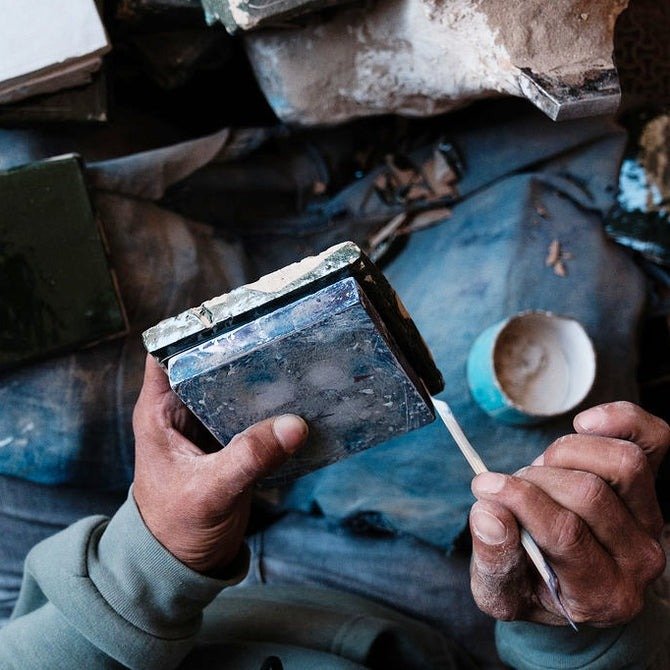
Every tile leaving our Rabat workshop is chiselled to its final dimension by a Maâlem working from memory and a wooden gauge — not a wet saw. The result is a surface with a fractional irregularity of roughly half a millimetre per tile, and that irregularity is precisely what makes a zellige wall read as light rather than as tile. This essay explains what that means for your setting-out drawings, your tolerances, and the moment on site when a contractor asks whether the panel is straight.
Words by Maâlem Abdelaly Ouedrhiri & the RabatArt studio · 12 July 2026 · 11 min read
Reading by theme
Eight standing collections rather than a tag cloud. Each one gathers what the atelier knows about a single part of the work.
14 editions
Moroccan Craftsmanship
How the work is actually done — gauges, chisels, kilns, and the hierarchy of the Maâlem.
9 editions
Traditional Architecture
Courtyard logic, proportion, light, and the Islamic geometry that governs a riad.
11 editions
Materials
Clay, lime, gypsum, cedar, tadelakt — where they come from and how they age.
7 editions
Heritage Restoration
Matching a technique that is centuries old instead of approximating it.
12 editions
Project Stories
Mosques, embassies, riads and residences, told from first sketch to final setting.
10 editions
Design Inspiration
Pattern families, colour palettes, and reference walls worth borrowing from.
8 editions
Behind the Workshop
Akkari, Rabat: apprenticeships, benches, firing days, and the people at them.
6 editions
Architect Insights
Specification notes, tolerances, lead times, and shipping — the practical file.
Latest editions
Long-form only. We publish when there is something worth an architect’s twenty minutes.

Materials
Tadelakt: the lime plaster that behaves like stone and breathes like skin
Burnished with a river stone and sealed with olive-oil soap, tadelakt is waterproof without a single sealant coat. What it asks of your substrate.
Salma Bennani · 2 July 2026 · 8 min

Project Stories
Setting 240 square metres of zellige inside a working mosque
A commission with no tolerance for error, delivered around five daily prayers. How the programme was sequenced.
RabatArt studio · 24 June 2026 · 12 min

Heritage Restoration
Reading a damaged riad ceiling before touching it
Restoration begins with a survey of the original craft logic — the carving sequence, the pigment, the joinery — long before the first repair.
Youssef El Ansari · 15 June 2026 · 10 min

Architect Insights
Specifying Moroccan ornament from abroad: a practical checklist
Lead times, crate sizes, customs paperwork, site tolerances, and the four drawings we need from you before production opens.
RabatArt studio · 6 June 2026 · 9 min

Moroccan Craftsmanship
Hand-carved gypsum: five weeks between a drawing and a ceiling
Gebs is carved wet, in place, against the clock. The window between set and dry is where the whole craft lives.
Maâlem Abdelaly Ouedrhiri · 28 May 2026 · 7 min

Traditional Architecture
The courtyard as a climate machine
Before it was a composition, the riad courtyard was a cooling strategy. The geometry follows the physics.
Salma Bennani · 19 May 2026 · 11 min

Materials
Middle Atlas cedar: why we still cut it by hand
Grain direction decides the carving. A machine cannot read it; a Maâlem reads it in seconds.
Youssef El Ansari · 9 May 2026 · 8 min

Behind the Workshop
A day in Akkari: firing, cutting, and the apprentices’ bench
The workshop day runs on the kiln, not the clock. What an apprentice does in the first year, and what he is not allowed to touch.
RabatArt studio · 30 April 2026 · 6 min

Project Stories
An embassy lobby in the Gulf, shipped in eleven crates
Cut in Rabat, numbered, crated, flown, and set by the same hands that shaped it. The logistics record.
RabatArt studio · 21 April 2026 · 10 min
Guides
What is Moroccan zellige? A definitive guide
Where it comes from, how it is made, how to recognise the real thing, and what it costs to specify. The reference page for anyone meeting zellige for the first time.
RabatArt studio · 18 July 2026 · 13 min

Costs & Comparisons
How much does handcrafted Moroccan zellige cost?
An honest breakdown by square metre: pattern complexity, glaze, cutting time, crating, and shipping — with the four factors that move the price most.
RabatArt studio · 14 July 2026 · 9 min

Costs & Comparisons
Zellige vs. ceramic tile: what actually differs
Surface, tolerance, light, lifespan, and cost. A side-by-side comparison for architects deciding between the two on a real budget.
Salma Bennani · 8 July 2026 · 8 min

Project Planning
How to restore a traditional riad, step by step
Survey, structure, drainage, then ornament — in that order. The sequence that keeps a restoration from having to be done twice.
Youssef El Ansari · 1 July 2026 · 14 min

Design Advice
Moroccan design ideas for contemporary villas
Where handcraft belongs in a modern plan: one wall, one ceiling, one threshold. How to use ornament without turning a house into a pastiche.
Salma Bennani · 26 June 2026 · 10 min

Guides
How to clean and maintain zellige tiles
No acid, no bleach, no sealant. What zellige actually needs over a fifty-year life, indoors and out.
RabatArt studio · 20 June 2026 · 6 min
Explore our expertise
Where the Journal ends, the work begins. Three ways into the atelier.
Receive each new edition
One letter a month from the atelier in Rabat
A new essay, a material note, and one project in progress. No promotions. Architects and design studios welcome.
Next — The Work